AAC Awareness Month 2026: AAC in Everyday Life, Today, Tomorrow and Beyond
Communication is a fundamental human right. It shapes how we share our thoughts, build relationships, and navigate the world. This October, LifeTec is proud to celebrate AAC Awareness Month, an opportunity to recognise the many ways people express themselves and raise awareness of Augmentative and Alternative Communication (AAC).
This year's theme, “AAC in Everyday Life: Today, Tomorrow, and Beyond,” highlights how the right tools support people to communicate, participate, and connect in the places and situations that matter most to them.
At LifeTec, our Speech Pathologists work closely with individuals, families and their support networks to explore communication options tailored to their individual goals and everyday lives, including people accessing support through the NDIS and other funding pathways.
To mark AAC Awareness Month 2026, we asked our Speech Pathologist, Bryan, to share his perspective on AAC, the assessment process and what makes a communication system work for the person using it.
Meet Bryan, LifeTec Speech Pathologist
1.For someone who hasn't heard of AAC before, how would you explain what it is?
“AAC (or Augmentative and Alternative Communication) is a type of Assistive Technology that can help increase a person's social independence.
It can support people to communicate whatever they want, wherever they want and however they want.
AAC can provide additional ways for people to express themselves and participate in everyday life.
2.Who might benefit from AAC?
“AAC can benefit anyone who experiences communication difficulties.
This could include people who have a reduced ability to verbalise themselves or people with language impairments associated with developmental or neurological conditions.
Everyone's communication needs are different, which is why finding the right approach for each person is so important.”
3.What does an AAC assessment at LifeTec usually involve?
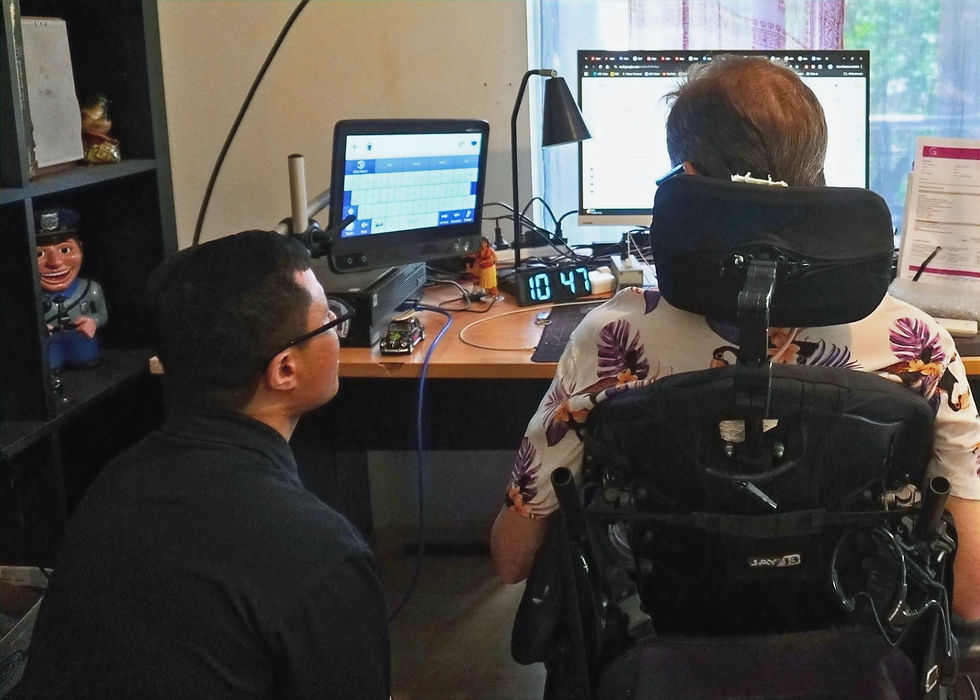
“After an initial appointment to identify goals and prioritise the areas that need support, I work with the person in their natural environment to understand their communication profile.
This helps us understand how communication affects the person's everyday life and social contexts.
From there, we can plan and arrange appropriate Assistive Technology options for trial and explore solutions that address the person's functional communication needs.”
4.What are some of the different AAC options people might explore?
“There are many different AAC options, depending on the person's needs and preferences.
Someone might explore a high-tech or low-tech communication system. Others may explore different communication programs or apps on their own tablet, or different hardware options that can be used as a dedicated communication device.
There isn't one AAC solution that works for everyone.”
5.Why is it important to trial AAC before deciding on a particular system?
“Trialling different AAC options allows us to evaluate whether they are effectively addressing the person's functional communication needs.
It also helps us identify the specific features and adaptations that can be tailored to the individual.
A trial gives the person an opportunity to experience how a communication system works in their everyday life, rather than simply choosing a device based on its features.”
6.What do you enjoy most about working with people who use AAC?
“I enjoy finding the right fit of communication system for each person.
It's incredibly empowering for people to have the ability to communicate whatever they want and whenever they want.
Seeing a person gain greater independence and social connections in how they communicate is one of the most rewarding parts of this work.”
7.What is one common misconception about AAC that you would like to clear up?
“Prescribing a device or an app is only one part of success.
Training and support from communication partners are essential for an AAC user to make the most of their prescribed device.
Family members, carers, teachers, support workers and other people in the person's life can all play an important role in supporting communication.
AAC works best when the people around the AAC user understand how to support and encourage their communication.”
8.For AAC Awareness Month, what is one thing you wish more people understood about communication?
“An effective AAC prescription is always the outcome of a collaborative approach between the prescribing therapist and the person's team of communication partners.
AAC isn't simply about finding a device. It's about understanding the person, their communication needs, their everyday environments and the people they communicate with.
When everyone works together, AAC can become a meaningful part of everyday life.”
AAC Awareness Month 2026: Supporting Communication in Everyday Life
The theme for AAC Awareness Month reminds us that communication doesn't just happen inside a therapy clinic. It happens at the dinner table, in the classroom, at work, hanging out with friends, and in all the small moments in between.
The right AAC solution empowers individuals to express their needs, share their unique thoughts, make choices, build relationships, and live more independently.
At LifeTec, our Speech Pathologists work alongside individuals, families and support networks to explore AAC options and find solutions that fit each person's communication needs and daily life.
Because everyone deserves a way to communicate.
Want to learn more about AAC?
Our team can help you explore AAC options, including assessments, equipment trials and guidance on suitable assistive technology and supporting documentation, where applicable.
Call: 07 3552 9000
Email: mail@lifetec.org.au
Refer online: AAC Referral